
There is a point in almost every renovation when practical decisions suddenly become visual decisions. The plumbing has been planned, cabinets measured, walls prepared—and then someone asks, “So, what tile are we actually using?”
That question can change the entire character of a room.
Natural marble has a presence that manufactured surfaces often try to imitate but rarely reproduce completely. The variation in veining, slight differences in tone, and movement from one piece to another create a surface that feels less manufactured and more architectural. A carefully selected marble mosaic tile can turn a relatively simple shower, kitchen backsplash, entrance, or powder room into the part of the project people remember.
At the same time, marble is not a material to choose blindly. Color variation is real. Different finishes behave differently. A mosaic that looks spectacular on a vertical backsplash may require more thought when installed on a wet shower floor. Installation quality matters. Ordering enough material matters too.
That is exactly why choosing marble should involve more than searching for the lowest price.
The better approach is to understand the stone, the pattern, the location, and the practical demands of the room before making the final decision.
Why Marble Mosaic Tile Still Has Such Strong Design Appeal
A marble mosaic tile works differently from a large-format stone tile.
Large marble pieces showcase broad veining and create a calmer, more continuous appearance. Mosaic pieces introduce another design layer: pattern. The stone provides natural movement while the mosaic geometry adds rhythm.
That combination can be remarkably effective.
Think about a white Carrara mosaic laid in a herringbone pattern. From across the room, the eye notices the directional design first. Move closer and subtle gray veins begin to appear across individual pieces. Neither element has to dominate.
Now compare that with a bold Calacatta marble mosaic. The stronger veining can create a more dramatic composition, especially when paired with understated cabinetry, brushed metal fixtures, or neutral walls.
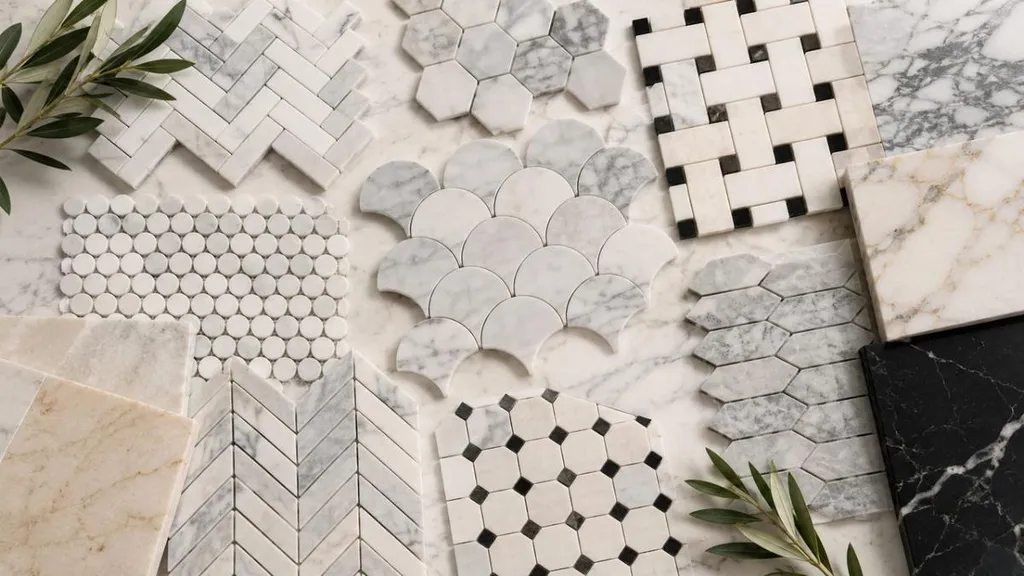
Surfaces Galore offers marble mosaics in materials including Carrara White, Calacatta Gold, Statuario, Thassos White, Dolomite, Nero Marquina, Crema Marfil, Tundra Gray and other natural stones. The collection also includes patterns such as herringbone, hexagon, basketweave, penny round, chevron, octagon and picket designs, among many others.
That variety matters because choosing marble is not simply a question of white versus gray.
Pattern can have just as much influence on the finished room as the stone itself.
Natural Variation Is a Feature—But You Need to Plan for It
One of the first things a homeowner should understand about marble is also one of its greatest attractions: no two pieces are exactly alike.
Natural stone does not come off a printer.
A tile may contain a darker vein. The next piece may be noticeably quieter. Another may contain a warmer undertone. When many pieces are installed together, those differences create depth.
This is beautiful when handled intentionally.
It can be frustrating when someone expects every tile to look identical.
Imagine opening several boxes of Carrara marble and finding that one group appears slightly whiter while another has more visible gray movement. An inexperienced installer might simply work box by box. The result can be an obvious patch of lighter material next to a noticeably darker section.
A better installer will normally examine material from multiple boxes and distribute the variation throughout the installation.
“Don’t install marble one box at a time—compose the surface.”
That is good advice for almost any natural-stone project.
Before installation begins, dry-lay several sheets or pieces. Look at them under the actual lighting in the room. Move unusually dark or strongly veined pieces until the overall composition feels balanced.
A few minutes spent arranging the stone can dramatically improve the final appearance.
Choosing the Right Mosaic Pattern
The stone itself receives much of the attention, but mosaic geometry deserves equal consideration.
A marble mosaic tile changes personality depending on the pattern.
Herringbone for Movement
Herringbone creates direction.
It works particularly well on kitchen backsplashes, feature walls and shower walls where the repeating angles lead the eye across the surface.
For a traditional kitchen, Carrara herringbone can add enough detail without overwhelming shaker-style cabinetry.
In a more dramatic interior, dark marble or high-contrast veining can make the same pattern feel much more contemporary.
The disadvantage?
There are many grout joints, and alignment must be precise. Small inconsistencies become surprisingly visible because your eye naturally follows the pattern.
Hexagon for Classic Geometry
Hexagonal mosaics have a long history in bathroom design, but they do not necessarily feel old-fashioned.
Small white marble hexagons can produce a clean, almost understated surface. Larger hexagons emphasize individual pieces of stone and show more veining.
A hexagonal marble mosaic tile is particularly useful when you want visual detail without an obvious directional pattern.
It can therefore work beautifully on a shower floor.
Basketweave for Traditional Character
Basketweave mosaics immediately introduce decorative detail.
They often suit traditional bathrooms, elegant entrances and interiors influenced by classic European architecture. Used carefully, they feel established rather than trendy.
But context matters.
Combine an ornate basketweave floor with heavily patterned wall tile, dramatic countertops and decorative cabinetry and the room may become visually exhausting.
Sometimes the right decision is restraint.
Let the mosaic be the decorative moment.
Penny Round for Softer Lines
Bathrooms contain plenty of straight lines: glass panels, vanity edges, rectangular mirrors, cabinetry and shower niches.
Penny-round mosaics introduce curves.
That seemingly small change can soften the entire composition.
Carrara penny-round mosaics are among the styles offered by Surfaces Galore, alongside numerous other mosaic formats and natural-stone combinations.
Checkerboard for Stronger Contrast
Checkerboard marble has returned to many residential interiors because it can bridge classical and contemporary design.
Black-and-white combinations are obvious, but softer gray-and-white or beige combinations create a quieter result.
A checkerboard entry floor, for example, can make a strong first impression while allowing surrounding walls and furniture to remain simple.
Where Marble Mosaic Tile Works Best
One advantage of marble mosaics is their flexibility.
They can be used selectively rather than covering every surface.
Surfaces Galore presents marble mosaics for kitchens, bathrooms, living spaces, shower floors, walls, backsplashes, hallways and other interior applications, with options available in polished, honed, tumbled and other finishes.
The correct choice, however, depends heavily on location.
Kitchen Backsplashes
A backsplash is one of the easiest places to make marble the visual focus.
You are working with a relatively limited amount of material, which means choosing a more distinctive marble mosaic tile may still fit comfortably within the overall renovation budget.
Consider this scenario.
A kitchen has matte white cabinetry, pale oak flooring and simple brass hardware. A plain white backsplash would work perfectly well.
But install a softly veined Calacatta mosaic behind the stove and the room suddenly gains another layer.
The important word is “softly.”
Not every feature surface needs maximum contrast. When cabinetry, countertops and marble all compete for attention, the result can feel disorganized.
A good rule is to decide which surface deserves to lead.
Marble in the Shower: Beauty Meets Practical Reality
Marble showers look extraordinary when they are designed and installed correctly.
They also illustrate why stone selection should include practical thinking.
A polished surface can reflect light beautifully on shower walls. On the floor, however, traction becomes a larger concern.
Smaller mosaic pieces naturally create more grout lines, which can help provide additional grip underfoot. Surfaces Galore specifically includes slip-conscious mosaic options intended for shower floors and wet areas.
Still, the finish should always be considered carefully.
Honed marble typically creates a softer, less reflective appearance. Polished marble looks brighter and can emphasize color and veining.
Neither is automatically “better.”
The question is where it will be installed.
A Practical Shower Example
Suppose you are designing a walk-in shower using large-format white marble wall tile.
Using exactly the same large tile on the shower floor may create installation challenges because the floor must slope toward the drain.
Instead, choose a related marble mosaic tile for the floor.
A 2-inch hexagon or another small mosaic format can follow the slope more naturally. It also adds a subtle pattern while preserving the overall stone palette.
You get visual continuity without forcing one product to perform every job.
That is smart design.
Polished vs. Honed Marble
People often choose between polished and honed marble based purely on photographs.
That can be misleading.
Light changes everything.
Polished Marble
Polishing creates a reflective surface that tends to make veining and color appear stronger.
It can look particularly striking on:
• backsplashes• feature walls• bathroom walls• decorative borders• fireplace surrounds
Polished marble can create a more formal feeling, especially when combined with brass or polished metal fixtures.
Honed Marble
Honed stone has a softer, matte appearance.
It absorbs light rather than reflecting it as strongly, often giving the material a calmer architectural character.
A honed marble mosaic tile can work extremely well in bathrooms, entrance areas and interiors where the designer wants natural stone without excessive shine.
Surfaces Galore carries mosaics across polished, honed and tumbled finish options, with many products available in more than one finish.
The best way to decide?
Order a sample and look at it inside your actual room.
A stone viewed under showroom lighting can behave very differently beside your cabinets, wall paint and natural daylight.
Searching for Marble Tile for Sale: Price Should Not Be the Only Filter
Anyone renovating a home eventually types something like marble tile for sale into a search bar.
There is nothing wrong with comparing prices.
There is, however, a difference between finding a good price and simply finding the cheapest stone.
Natural marble varies in selection, consistency, cutting quality, calibration and finish. Shipping also becomes important because stone is heavy and breakable.
Surfaces Galore positions its collection around premium natural stone rather than low-grade commercial material and offers insured shipping, samples and assistance with choosing material. The company states that most orders ship within hours and that samples are available before committing to a larger purchase.
When evaluating marble tile for sale, ask several questions beyond cost:
• Is the material genuine natural stone?• What finish is provided?• Is the listed size nominal or exact?• Can you see or order a sample?• Is the material appropriate for the intended location?• What happens if pieces arrive damaged?• Can additional matching material be ordered later?
The last question is frequently overlooked.
Imagine buying exactly 100 square feet for a 100-square-foot project.
During installation, several pieces need cutting. Two break. Another few contain veins you would rather position elsewhere. Suddenly there is not enough material.
Now you reorder.
But natural stone from a later shipment may not match the original batch perfectly.
The supposedly economical order becomes a headache.
How Much Extra Marble Should You Buy?
Stone projects normally require waste allowance.
The appropriate percentage depends on the pattern, room shape, tile size, installation layout and how much visual selection you plan to do.
Simple layouts generally create less cutting waste.
Diagonal patterns, herringbone layouts, rooms with many corners and highly selective natural-stone installations can require more.
For many straightforward tile projects, buyers often consider roughly 10% extra material as a starting point, while complicated layouts may justify a larger allowance.
But treat that as planning guidance rather than an absolute formula.
Measure the room carefully and discuss the layout with the installer before ordering.
Buying slightly too much may feel wasteful.
Buying too little halfway through installation feels considerably worse.
Keep several unused pieces after the project too.
Years later, if plumbing work or accidental damage requires replacing a small section, having matching stone from the original batch can be extremely valuable.
Why Samples Matter When You Buy Marble Tiles Online
It has never been easier to buy marble tiles online, but photographs have limitations.
Screens affect color.
Lighting affects color.
Photography affects color.
And natural stone varies by definition.
A sample is therefore not merely a sales accessory. It is part of the design process.
Surfaces Galore offers samples so buyers can evaluate the color and texture of materials before placing a larger order.
Put the sample beside everything it will touch.
Cabinet door.
Countertop.
Flooring.
Paint sample.
Metal fixture.
Then look again in the morning and evening.
A marble that appears bright white under strong artificial light may reveal warmer or grayer tones under daylight.
That discovery is much cheaper before ordering hundreds of square feet.
Buying Marble Online Without Losing Control of the Project
Some homeowners still hesitate to buy marble tiles online because they cannot personally inspect every box before purchasing.
That concern is understandable.
The solution is not necessarily avoiding online purchasing. It is creating a better selection process.
Start with material.
Then pattern.
Then finish.
Then application.
Then quantity.
Only after those decisions should price become the final comparison.
If you begin with hundreds of products and no criteria, everything starts looking equally attractive.
Instead, narrow the search deliberately.
For example:
“I need a white natural marble mosaic for a shower floor, preferably honed, with moderate gray veining and a pattern small enough to follow the floor slope.”
Suddenly the decision becomes much easier.
That is considerably more useful than simply searching “white marble.”
Carrara, Calacatta, Thassos or Dolomite?
Several white stones frequently appear in marble interiors, but they create different moods.
Carrara White
Carrara is associated with a softer white-to-gray background and recognizable gray veining.
It tends to feel understated and adaptable.
A Carrara marble mosaic tile works particularly well when you want natural movement without making the stone overwhelmingly dominant.
It pairs comfortably with:
• white cabinetry• gray cabinetry• natural wood• chrome fixtures• brushed nickel• black accents
Calacatta Gold
Calacatta Gold generally creates a stronger decorative statement.
Its creamy white background and more dramatic veining—including warmer golden movement—can make it feel richer and more expressive.
Surfaces Galore offers Calacatta Gold in both tile and mosaic formats and describes it as an Italian marble available in polished and honed finishes.
This is a material I would use selectively if the rest of the room already contains strong visual elements.
Thassos White
Thassos is known for its clean white appearance.
It works especially well when contrast comes from pattern or from pairing it with another marble.
A Thassos basketweave mosaic combined with a darker accent stone, for instance, can produce a highly traditional yet crisp bathroom floor.
White Dolomite
Dolomite offers another pale option, often with delicate gray veining.
Surfaces Galore features White Dolomite among its natural-stone collections for floors, walls and showers.
It can be an interesting choice when you want a light surface that does not exactly repeat the familiar look of Carrara.
Grout Color Changes the Entire Mosaic
Grout is not simply what fills the spaces between tile.
With mosaics, it becomes part of the pattern.
Imagine white marble hexagons installed with bright white grout.
The joints visually recede, so the surface reads primarily as marble.
Use darker gray grout and every hexagon becomes more obvious.
Neither result is wrong.
They are simply different.
For a herringbone marble mosaic tile, stronger grout contrast emphasizes direction dramatically. With a subtle basketweave, contrasting grout may reveal details that would otherwise disappear.
Before committing, test grout against an actual sample.
Also remember that highly contrasting grout can draw attention to small inconsistencies in installation.
A perfectly aligned pattern looks fantastic.
An imperfect one becomes harder to ignore.
Installation Is Not the Place to Cut Corners
Expensive marble installed badly will look worse than modest tile installed well.
That may sound harsh, but it is true.
Natural stone requires careful preparation, consistent setting material, suitable adhesives, accurate cuts and thoughtful layout.
Mosaics bring their own challenge: sheet lines.
Many mosaics arrive mounted on mesh-backed sheets. If each sheet is installed without adjusting the individual pieces, the finished wall can reveal a subtle grid.
Once you see it, you cannot stop seeing it.
An experienced installer will often manipulate spacing between sheets and individual mosaic pieces so the repeated sheet boundaries disappear.
This requires time.
It also explains why comparing installation quotations based only on price can be risky.
Ask potential installers whether they regularly work with natural stone and mosaics.
Better yet, ask to see previous work.
Sealing and Maintenance: Marble Is Beautiful, Not Indestructible
Marble is natural stone, and natural stone requires appropriate care.
Depending on the specific product and installation, sealing may be recommended to reduce absorption and make maintenance easier.
That does not mean marble becomes immune to staining or chemical damage.
Acidic cleaners are particularly problematic because they can affect calcium-based stone.
Use cleaning products intended for natural stone.
In a kitchen, wipe spills rather than letting acidic substances sit on the surface.
In a shower, routine cleaning helps prevent soap residue from building up around grout joints and textured areas.
This is the compromise with authentic materials.
Wood can scratch.
Natural stone can change.
Metal can patina.
People often choose these materials precisely because they develop character.
If your priority is a surface that looks identical forever with minimal care, marble may not be your ideal material.
If you appreciate natural variation and are comfortable with reasonable maintenance, few materials create the same atmosphere.
When Custom Marble Mosaic Makes Sense
Sometimes the standard catalog gets you 90% of the way there.
The remaining 10% matters.
Perhaps you like a particular geometric pattern but want a different stone combination. Maybe a designer needs a mosaic that repeats colors already present in a larger floor installation.
Custom mosaics can solve that problem.
Surfaces Galoreoffers custom marble and travertine mosaic options where colors, stones and patterns can be combined for walls, floors and backsplashes.
Custom work makes particular sense for:
• high-end entrances• hotel or hospitality projects• decorative shower niches• feature walls• border designs• historically influenced renovations• coordinated bathroom schemes
There is a cost and complexity trade-off.
Custom pieces require more planning.
Yet when the mosaic becomes a central architectural feature rather than simply another surface, that additional effort can be justified.
A Realistic Design Scenario: Building a Bathroom Around One Mosaic
Consider a medium-sized primary bathroom.
The owner likes marble but is worried that covering every surface in heavily veined stone will feel excessive.
Instead of forcing marble everywhere, the design begins with one marble mosaic tile.
A soft Carrara hexagon is selected for the shower floor.
Large-format pale stone tiles are used on the shower walls. The vanity is warm oak. The countertop remains mostly white. Brushed nickel fixtures connect visually with the cooler gray veins in the Carrara.
The marble appears again inside the shower niche.
Nothing else needs to match perfectly.
That repetition is enough to make the design feel intentional.
Now imagine the alternative: dramatic mosaic floor, heavily veined marble walls, patterned countertop, strong cabinet grain and decorative wallpaper.
Each material might look beautiful independently.
Together?
Maybe too much.
Luxury is not created by adding the maximum amount of expensive material. It is created by making the right materials feel deliberate.
Common Mistakes When Choosing Marble
The most expensive mistakes often happen before installation begins.
Choosing From One Photograph
A product photo is useful for understanding pattern and general color.
It should not be treated as a guarantee that every natural-stone piece will look identical.
Ignoring the Rest of the Room
A beautiful marble mosaic tile can still be the wrong marble for your kitchen.
Take surrounding materials seriously.
Ordering Exactly the Measured Quantity
Cuts, breakage and natural selection create waste.
Plan for it.
Choosing Pattern Without Considering Scale
Tiny mosaics create visual activity.
Large spaces can absorb that activity comfortably.
In a very small room with multiple competing surfaces, complicated patterns may make the space feel busier than expected.
Forgetting About Grout
Grout can either soften the mosaic or outline every individual piece.
Decide before installation, not while the installer is waiting.
Hiring an Installer With Little Natural-Stone Experience
Marble rewards precision.
Saving money on installation can become expensive if material must later be removed or replaced.
How to Make a Better Decision Before Ordering
Before you buy marble tiles online, create a simple project checklist.
First, decide where the stone will be installed.
Then choose the visual direction: quiet, dramatic, traditional, modern, warm or cool.
Next, choose a marble family.
After that, compare patterns.
Then evaluate polished versus honed or another appropriate finish.
Order a sample.
Place it in the actual room.
Discuss the material with your installer.
Measure carefully and include an appropriate waste allowance.
Only then place the full order.
This process sounds slower than clicking “add to cart.”
In reality, it can save days of frustration later.
Why Marble Mosaic Tile Can Be Worth the Extra Thought
There are cheaper surfaces.
There are easier surfaces.
There are materials with almost no natural variation at all.
And yet designers and homeowners continue returning to marble.
Why?
Because marble does something subtle.
It changes as you move through the room.
Veining becomes more visible from one angle. Polished surfaces catch light. Honed surfaces soften it. Small mosaic pieces create texture even when the colors remain quiet.
The material does not have to shout.
In fact, some of the most successful marble interiors are remarkably restrained.
A single backsplash.
A shower floor.
A fireplace surround.
A small entrance.
One carefully chosen marble mosaic tile can sometimes contribute more to a room than covering every available wall in decorative stone.
Final Recommendation: Choose Marble as Part of the Whole Room
If you are comparing marble tile for sale, do not begin by asking, “Which one is cheapest?”
Begin with a better question:
“What should this room feel like when it is finished?”
For quiet elegance, Carrara, Dolomite or another softly veined stone can work beautifully.
For stronger character, Calacatta Gold, Nero Marquina or contrasting mosaic combinations can become the focal point.
For wet areas, pay particular attention to tile size, finish, grout joints and installation requirements.
When you buy marble tiles online, use samples whenever possible, calculate enough extra material and remember that natural variation is not a manufacturing defect—it is part of what makes genuine stone interesting.
Above all, treat your marble mosaic tile as part of an entire composition rather than an isolated product.
Cabinetry, metal finishes, lighting, grout, countertops and neighboring floor materials all affect how the marble will eventually look.
The strongest projects are rarely the ones with the most elaborate materials. They are the ones where every decision seems to belong.
Choose the stone carefully, see it in your own space, plan the layout before installation, and let the marble provide the character that manufactured imitation can never reproduce exactly.